
Written By - Gabriele De Capitani
Pointy things and Colorful things
Thung Nham, Ninh Binh - Vietnam
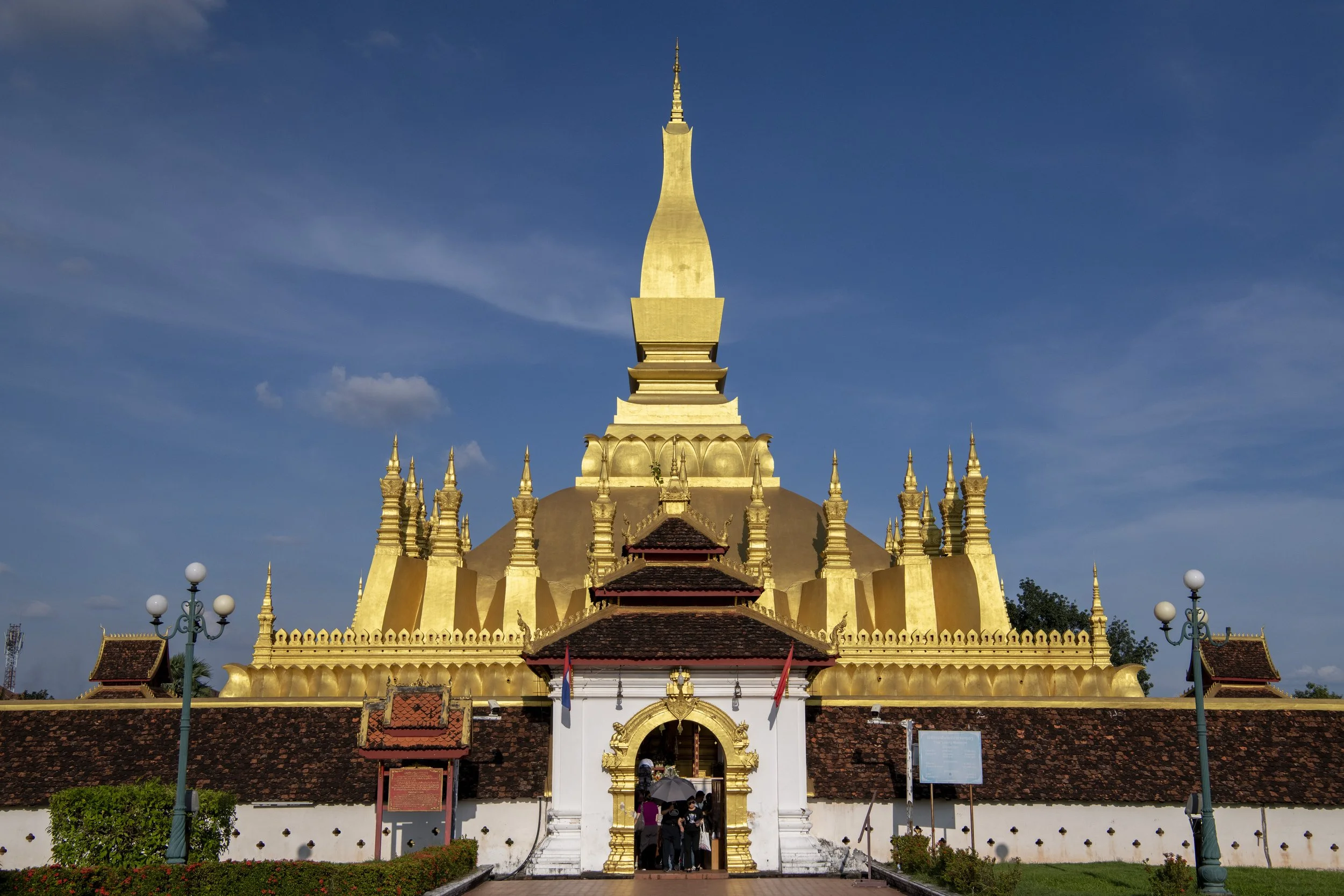
The Pha That Luang is perhaps the most historically and culturally significant monument in Laos. Built in 1566, its contruction becan in 1566 over an original, much simpler shrine, originated arround 300 B.C. This Stupa is, very clearly, painted golden, with its top being coated in actual pure gold. It’s quite a spectacle to see, with its colors at times blinding in the sun and quite impossible to ignore even at a distance. It’s the ultimate symbol of Laos and its relationship with Buddhism. What was even more interesting, to me, were the archeological archives visible within the walls surrounding the monument, depicting paintings and photos through the centuries. This monument withstood erosion, damage, and restaurations over thousands of years, and it was quite incredible to see it’s resistance throught thousands of years, wars, occupations and rebellions, while initially a lone monument surrounded by jungle, later made accesible to french charriots, then paved for early motorcars, and now surrounded by the countrie’s capital.
and Finally, the pointyness: Laotian cultural and religious beliefs brought archetectural creations to be so pointy thanks, in particular, to the use of pillars which, if looked at closely reseble an eloganted lotus flowre Bud . the Lotus is a symbol of purity, discconnecting from the ground and reaching ror the sky, this same action of reaching for something purer than the human state is also represented with the use of such pointy shapes.
Composition-wise, I chose a very formal, classic, and mirrored style, acknowledging how this temple stood high, in the center of so many historical events, with the world changing around it.
With a closer eye you might notice that the pinnacles of the gate, smaller columns, and main top of the stupa do not perfectly align. If you must know, this made me very upset, and after 25 minutes of walking around trying to find the perfect angle, I decided to give up and acknowledge that the monument itself, and subsequent statue placement (not visible in the picture), while visually and culturally impressive, were sadly not built symmetrically.
Wandering in a temple, I was surprised by the mix of respect and daily life and activities that were occurring inside. I am a visitor in a new country and unaware of cultural customs, so I always act as respectfully as possible, often even more reserved than the local people, as I am not tied to this particular religion. In this instance, I felt comfortable enough to search for a new angle to photograph my environment, so I chose to go behind the Buddha statue, initially planning to take a POV shot of what the sculpture would see, rather than the usual opposite. Instead, I decided in my mind that I don’t deserve to take a picture of others praying/meditating and praising me/the camera, as this, regardless of whether you believe it or not, is an intimate moment that deserves respect, not a view for me or anyone to have over others.
Wat Si Muang Nakhon, Vientiane - Laos
Outside Wat Si Muang Nakhon, Vientiane - Laos
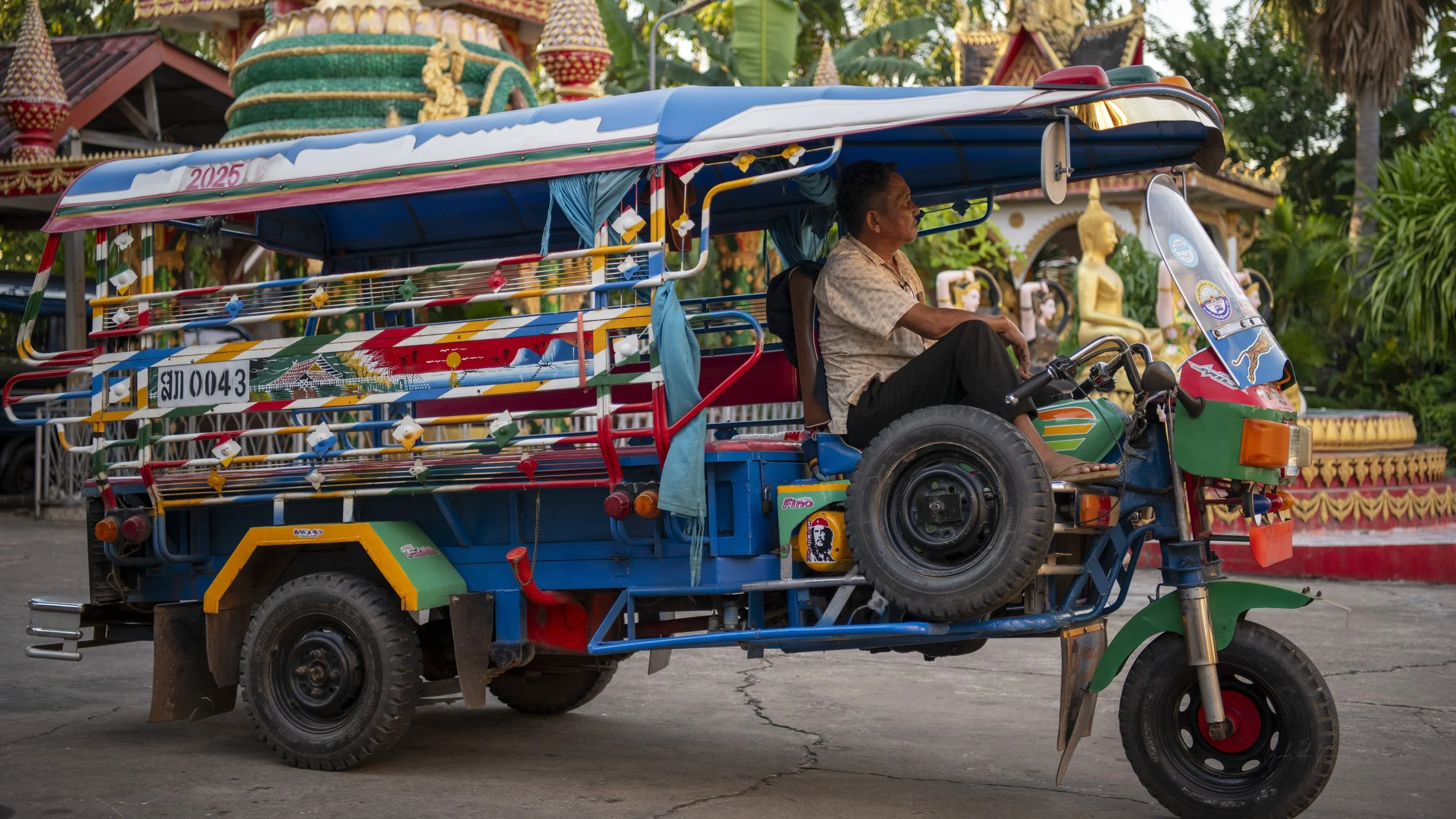
And now, the famous Tuk-Tuk, which I was actualy told by a local they are not really called TukTuk, but people visiting from Thailand called them TukTuk so now evveryne calls them TukTuk even though evveryone knows they are not really called TukTuk but at the same time no one told me how they are really called… anyways… as i was saying… TukTuk!
This beautifully colored motorizet trycle is the main local way of transportation within and between cities, if you are lucky, the two long back seats will have a back rest and some cushioning, if not, you will get a metal rod and a wooden plank. My recod on one of theese is 6 hours, unfortunately on the wooden plank kind, but that’s a story for another time. AS you can see, the cultural use of vibrant colors and motifs beautifuly decorates this specamin of speed and ecological efficiency (only one of those is true), ordained with personalized art and stickers, and compleated with the Che Guevira icon on what i assume is an air presure tank (but i’m no mechanic). You are not allowed to drive this with shoes and if tehre are less than 6 people in the back you have to pay extra (my personal record is 32, not joking, and 4 3 were standing outside in the back, only 2 remained at the end of the trip, but that’s another story for another other time.
Wat Si Muang Nakhon, Vientiane - Laos
Taking a small break from analysing architecture and art, I’d like to share this mundane picture of local people interacting with a monk within the temple. Despite having visited many temples before, this was my first time seeing a “mundane” activity such as this. After asking for information, I was told that families and individuals can bring donations to the monks who, in exchange, bless them. Monks, in fact, are not allowed to “work” per se and therefore rely on donations from the community to feed themselves. One of the monks’ roles is to bless and meditate for other people. AS I generally imagined temples deprived of objects that regularly belong to daily life, I was not expecting to see so much food and drink within a place of prayer, so I took this picture to depict the other, more human, side of temples.
In this image, we can see the crown of the Buddha statue, and we might also notice how similar it is to the Stupa; in fact, it is a miniaturized one.
We can notice in more detail the lotus-like motifs, and its conical, spired shape is a reference to the sacred mountain Meru, which the Buddhists believe sits in the centre of the universe.
Similarly to the previous image, it was impossible to have perfect symmetry between the statue and its enclosure, which at the time further caused me discomfort.
I still made sure to use the enclosure to frame the subject, exposing and focusing on it while still maintaining some background to further achieve symmetry in it.
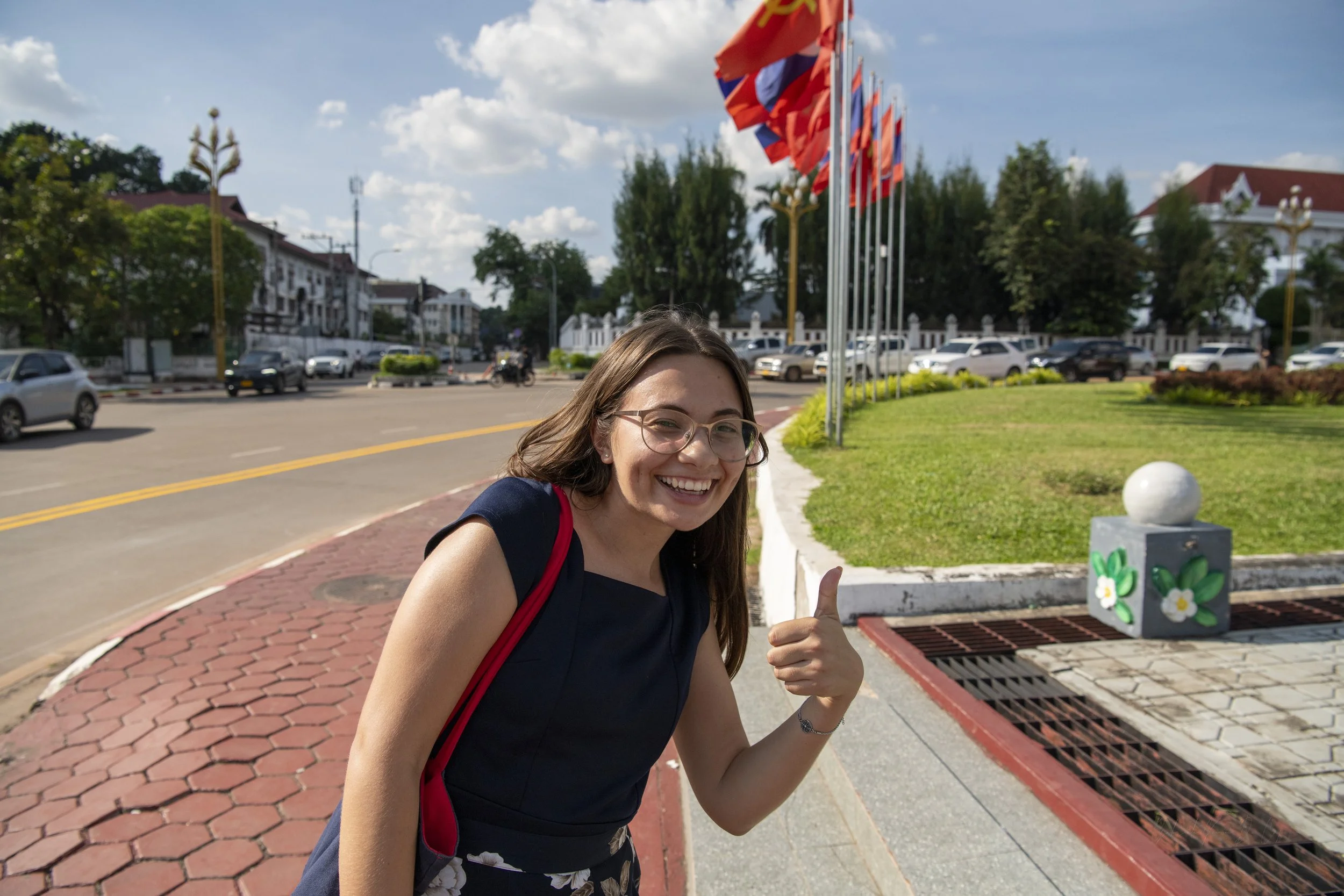
Jessica, American teacher, in front of Patuxai, Vientiane - Laos
I left here two pictures, one in it’s classic, cultural vibrant coors, and the other in black and white. the two styles and types of framing really spoke to me in different ways. The first, as a pure example of local culture, and while this particular subject was aimed at ttourist, it still gave me a more realistic feeling. and the second, i think staples more a cultural asset, or a moment in time, but I can’t quite convince myself if either is better or perfect.
I’d like to close this week’s publishing by thanking the very nice girl I met on my first day in this country. It being Sunday, I searched for a church and happily found one. Just as I entered, I made conversation with a young woman who seemed unsure how to navigate a church. I found out she was just giving it a go, and we ended up spending a nice day around the city, sharing local knowledge (mainly from her par, of course), just to meet once more and never again. And such is how it often goes while travelling: you meet very curious and fun people, have unique experiences, and likely never see them again. Either way, thank you, Jessica, for being my personal tour guide for a day, and I hope your philanthropy studies are going great!