
Written By - Gabriele De Capitani
City and Religion
Bãi Đính Pagoda , Ninh Binh - Vietnam
While I won’t pretend to know nearly enough about Buddhism to fully understand it, and being of Christian faith myself, I don’t base my life on its beliefs. Nevertheless, as with other religions, I have learnt to respect it.
It being, to my understanding, a peaceful teaching, aimed at reaching stillness and balance, I believe it’s intended to foster a positive impact in society. There are, still, a few things about the cultural application of these teachings that I’ve found interesting to learn about and, at times, a bit curious.
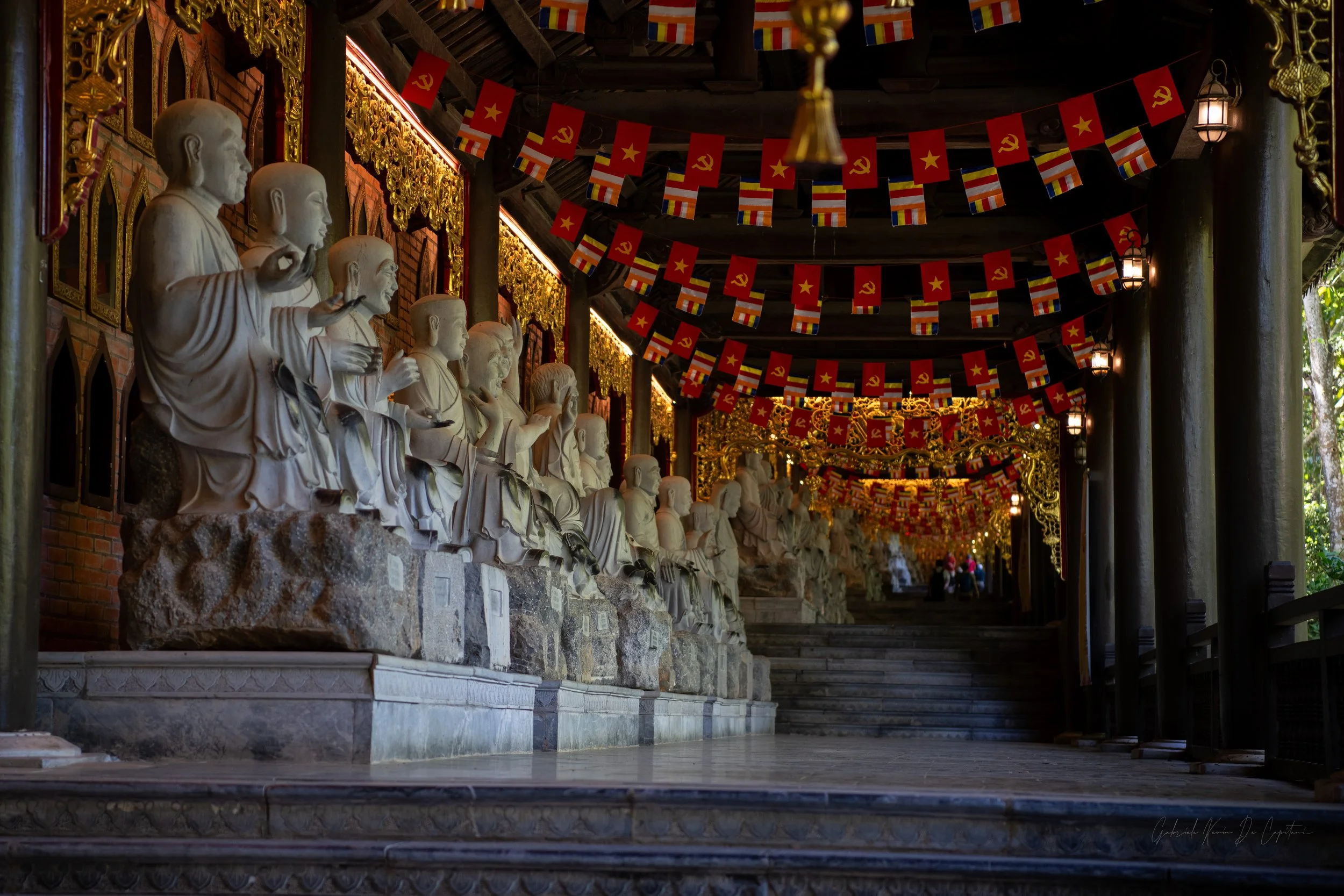
This photo was taken in the Bãi Đính Pagoda, a massive complex containing an ancient building founded in 1136, and the modern, larger part of the complex, completed in 2010. This picture captures part of the 3 km-long walkway containing 500 life-sized statues of Buddha, each in a different pose and different facial expression. You may notice some darker markings on the feet, hands, and knees. These are caused by people passing by, who believe that touching these statues and leaving monetary donations on them will bring them good luck. Quite a curious interpretation of Karma, which sparked an interesting conversation with our tour guide, who explained to us how different people interpret religious beliefs differently.
Behind the large stone statues are 1200 smaller golden identical statues (not visible) that were donated by families or individuals to help fund the construction of the temple. Finally, on the ceiling, alternating flags of Vietnam and those of the Buddhist temple decorate the walkway.
I felt this picture well represents the commitment the local people have to their religion, and the statues disappearing in the distance through the use of perspective, making them appear infinite, well demonstrate the magnitude of effort put into the physical representation of a religious belief.
Tượng Phật Thích Ca, Bãi Đính Pagoda, Ninh Binh - Vietnam
I present to you the largest golden sitting Buddha in Vietnam.
This 16m, 100-tonne statue is made of gold-plated bronze and is quite a spectacle to see in person. Never have I seen so much gold in one room, particularly from a statue staring straight at me as I entered the temple.
While walking through the quiet room, through people in prayer and tourist groups, in awe of this great statue, I stopped for a moment and wondered what would prompt the construction of such a massive and expensive symbol for a very spiritually and physically detached religion. After some thought, questions, and research, I’ve come to the understanding that the official purpose of massive constructions is that the state of Awe one finds themselves in when they admire it induces a sense of peace in the observers, aiding with the meditation process. While an abundance of gold is used as the material does not decay in time and therefore represents the “unchanging truth” of Buddhism.
In the foreground, to the left of the picture, I included some of the writings that were inscribed on pillars framing the statue. This section reads, in classical Chinese:
“Attaining the perfect status of Great Enlightenment”
“Preaching the wonderful Dharmas as countless as the sands of the Ganges River”
“Rescuing and liberating the sentient beings who are lost in the currents of delusions”
These are some of the missions the Buddha is set out to accomplish and represent.
While I must be honest and admit my knowledge of Chinese is very far from allowing me to read a column while taking a picture, in the moment of this picture, I figured that merging a visual with a written image of the same subject would be a descriptive way of representing it, so I chose to include it in the foreground, hoping for a good translation, which luckly had occurred.
A little secret for you: it happens often, even in very famous pictures, that a fortunate turn of events makes the picture much more meaningful. :)
Chùa Từ An, Ninh Binh - Vietnam
Walking around the waterfront, near another pagoda, I reached an area rich in vegetation, with local lanterns hanging from ancient trees. As the water was slowly flooding the path, I noticed a pattern of puddles and decided to experiment with taking pictures of the reflections of what I saw, rather than directly of the subject.
This felt different to me, as I was allowed to photograph only what the puddles of water reflected; in a way, the usually disruptive rain was allowing me to see something from a different perspective and guiding me to compose the picture.
In fact, as you might remember from what we have seen so far, the presence of the foliage, puddles, lanterns, and pagoda, I believe, fully encapsulates the most characteristic parts of Vietnam:
Nature, Water, Culture, and Religion.
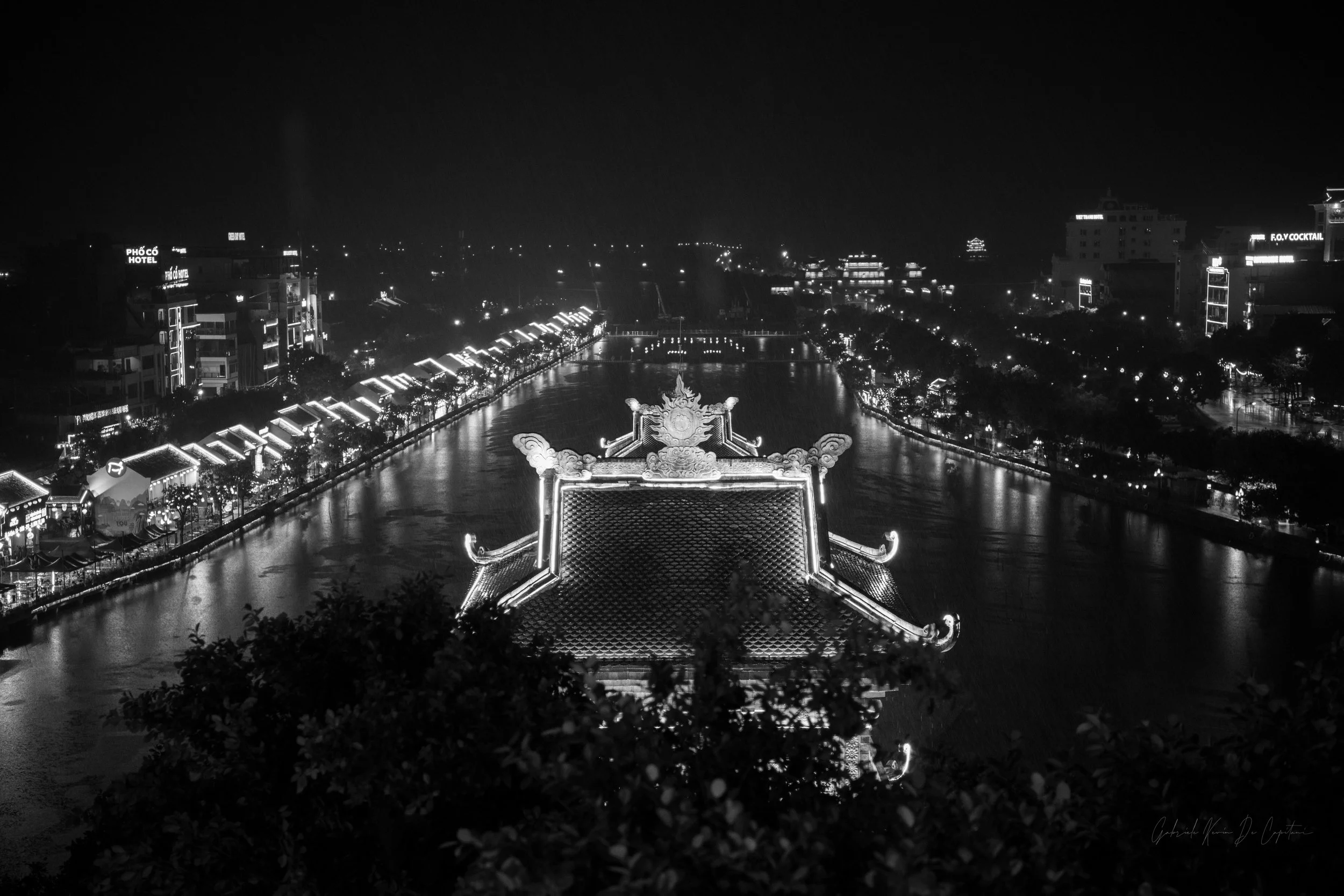
I leave you with this final picture of Vietnam.
A great mixture of ancient and modern, nature and manmade.
Climbing on top of a small mountain, through torrential rain,
wearing a gifted poncho.
Chùa Từ An, Ninh Binh - Vietnam
Chùa Từ An, Ninh Binh - Vietnam
One rainy evening, exploring the City of Ninh Binh, I came across a series of pagodas on a lake. Pagodas are another great example of religious architecture; they are places of prayer for Buddhists and house statues accompanied by storytelling art within their walls.
Just as I was framing the beautifully lit pagoda, the rain began to pour harder, causing me to capture the moment just before everyone started running to take cover.
I did, however, really appreciate how the ripples on the water, caused by the rain, concealed the reflection of the pagoda, almost dissolving it in the water.
Wanting a sense of perspective, I included the walkway, leading towards the building, waiting for someone to walk on it to lead the viewer towards the building.